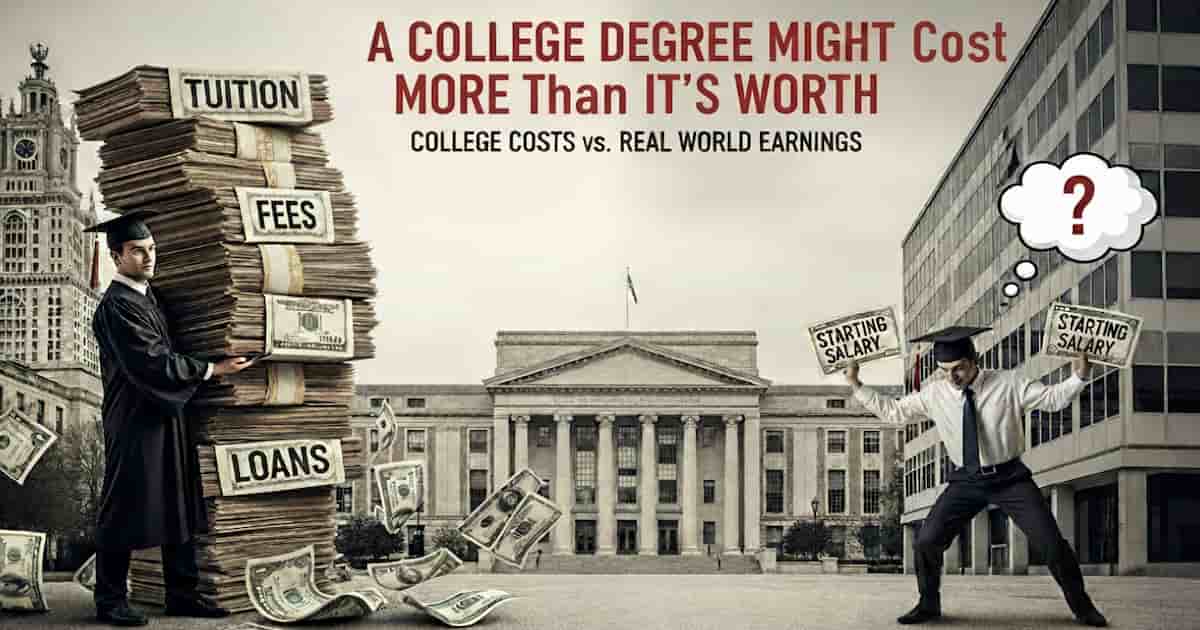

College Costs vs. Real World Earnings
You and a classmate leave high school with the same chances. The choices you make next can change your financial path for decades.
One person follows the usual route and takes student loans for a four-year degree. The other starts working, saves, and invests instead.
The numbers can create a large gap in net worth by your mid-20s. That gap can take decades to close depending on debt size, major, and career earnings.
You need clear math, not slogans, to decide if college makes sense for you. Costs have risen much faster than real wage gains for many majors.
Some degrees never pay back the price. Knowing typical loan amounts, likely starting salaries, and how long it takes to reach a net-worth break-even point will help you make a smarter choice about school, work, and saving.
Key Takeaways
- College can leave you worse off financially if your major and debt don’t justify the cost.
- Working and investing early can create a large net-worth lead that may take decades to erase.
- Understand costs, expected earnings, and loan terms before committing to college.
The Financial Reality of College Versus Working After High School
Two Paths: Sarah’s Degree and Mike’s Early Work
You watch Sarah follow the usual path: four years at a state university, a communications degree, and $100,000 in student loans by age 22.
You see Mike skip college, take an entry job making about $35–36k, live frugally, and invest steadily from age 18.
You compare outcomes at 22: Sarah has a degree and negative net worth from loans. Mike has work experience, no debt, and invested money growing in the market.
Size of the Net Worth Difference at Age 22
At age 22, the gap is large. Using the examples given, the person who skipped college has roughly $17,000–$22,000 invested and no debt.
The college grad has about $100,000 in loan debt. That creates a net worth gap of roughly $119,000–$122,000 in favor of the person who worked instead of attending college.
You also note that higher starting pay for the graduate doesn’t offset loan payments. Loan payments can exceed the extra income, leaving less available for living and investing.
When Earnings Catch Up: The Break-Even Age
You follow the modeled scenario to find the break-even age—the year the college grad’s net worth surpasses the non-college worker’s.
With these assumptions (100k debt at ~6.5%, median grad salary near $52k, 3% raises, 8% investment returns, and the non-college worker investing $300–$400 monthly), the crossover can occur decades later.
In the example, the college grad doesn’t overtake the non-college worker until the mid-50s in a median case. For lower-paying majors the break-even point can be age 65 or never.
For high-return majors like engineering or computer science, the break-even can come much earlier (around 30–35). Those majors represent a minority of degrees.
The Changing Economics of Higher Education
Rising Costs of Going to College
You face much higher sticker prices than past generations. Public four-year tuition, fees, and room and board rose from roughly $10,000 per year (adjusted) in 1980 to over $23,000 today for in-state students.
Private schools now average over $53,000 per year. That means real costs grew about 130% over 40 years while students still often borrow to cover the gap.
- Example: A typical student borrows $100,000 to cover a four-year degree.
- Effect: Larger loans mean bigger monthly payments and delayed ability to save or invest.
Flat Wages for Degree Holders
You do not see matching wage growth for most graduates. Since 2000, real wages for college graduates have been roughly flat.
You pay much more for college, but average earnings have not risen to match those higher costs. That reduces the financial advantage college once offered.
- Key point: Higher tuition + stagnant graduate pay = lower or delayed financial payoff.
How to Calculate Your Break-Even
You can model the trade-offs with a simple comparison of two paths: college with debt versus working and investing from age 18.
- Scenario assumptions used in the model:
- College grad borrows $100,000 at about 6.5% interest, graduates at 22, starts at $52,000 salary.
- Non-college worker starts at $35–36,000 at 18, invests $300–400/month in an index fund earning ~8% annually.
- Both receive ~3% annual raises; investments compound at 8%.
- Findings from the model:
- By age 22, the non-college worker can have roughly $17–22,000 invested and no debt, while the college grad is about $100,000 negative.
- With the example numbers, the college grad might not catch up in net worth until their mid-50s (age ~54). For lower-paying majors, the crossover can be at or beyond retirement (age 65) or never occur.
- High-earning majors (e.g., CS, engineering, nursing, accounting) can reach break-even much earlier — sometimes by age 30–35.
- Quick checklist to run your own break-even:
- Estimate total debt and interest rate.
- Project starting salaries and raise rates for both paths.
- Decide monthly investing amounts and expected return.
- Model net worth over time to find the crossover year.
Bold financial assumptions change outcomes dramatically.
Impact of Picking a College Major
Majors That Often Pay Back Quickly
- You can earn back the cost of some degrees fairly fast.
- Fields like computer science, engineering, nursing, and accounting tend to boost your pay enough that you may break even by your early 30s.
- If you choose one of these majors, your lifetime earnings premium is often clear and large.
Degrees That Leave You with Low Pay and Big Costs
- Some majors, like social work, psychology, and fine arts, often start with low early-career salaries.
- If you borrow heavily for these degrees, you might not recover the cost for decades — sometimes not before retirement.
- A quarter of college programs can leave graduates worse off financially than if they had skipped college.
Why Median and Average Earnings Tell Different Stories
- Averages can be misleading because a small group of very high earners skews the number upward.
- The median graduate — the person in the middle — usually sees a much smaller pay advantage than the average suggests.
- That gap matters: if you plan using median outcomes, many majors do not justify high tuition and heavy borrowing.
The Psychological and Systemic Traps Facing Students
Social Expectations and Degree Overvaluation
You were taught that college is the default path after high school. Society treats degrees as a moral must.
That pressure pushes many students into costly programs without checking the numbers first. You can end up borrowing large sums for degrees that pay little over a lifetime.
- Many majors pay only modestly more than high school work.
- Rising tuition has far outpaced wage gains for graduates.
- A degree’s value depends on the major, not the act of attending itself.
Loans Targeted at Young People
Lenders let you sign for big loans before you’ve earned or lived independently. You may sign loan papers at 17 or 18 without understanding monthly payments or long-term effects.
That makes you vulnerable to large, lasting debt before you can judge the investment.
- Students face loans comparable to mortgages but with no work history.
- Predatory lending practices exploit youth and inexperience.
- Early debt reduces your ability to save, invest, or build net worth.
Mental Biases: Denial and Sunk-Cost Thinking
Once you borrow and invest years in school, you may feel stuck even if the return is poor. You convince yourself the degree will pay off eventually, and you keep paying because of time and money already spent.
- You may ignore the math because you want to believe in your choice.
- Sunk-cost bias makes it hard to change course after investing time and money.
- Cognitive dissonance leads you to rationalize debt instead of confronting poor ROI.
Systemic Incentives and the Role of Institutions
College Price Drivers and How Costs Add Up
You see colleges charging far more now than decades ago. Tuition, fees, and living costs at public and private schools rose much faster than inflation over the last 40 years.
That means the price tag you face today often doubles what similar schooling cost your parents. When you borrow to cover those costs, interest and repayment terms can turn a degree into a long-term financial burden.
How Federal Loan Programs Change Choices
Federal student loans make large borrowing available to young people with little financial experience. You can sign loan documents as a teenager and take on six-figure obligations before you earn a steady paycheck.
Those loans lower the immediate barrier to enrolling, but they also create monthly payments that reduce your ability to save and invest for decades.
Workplace Degree Rules and Hiring Signals
Employers often list bachelor’s degrees as a requirement for many jobs, even when the role doesn’t need that training. This raises the perceived need to go to college and pushes you toward borrowing to meet job market rules.
A minority of majors produce most of the high-paying outcomes, while most graduates enter fields with modest wage gains but still carry high debt.
Framework for Making Informed College Decisions
Work out the full, real cost of college
List every expense you will face, not just tuition. Include fees, room and board, books, travel, and loan interest over time.
Put those numbers into a single annual and total cost so you see what you are actually borrowing.
Use a simple table to compare options:
| Item | Annual cost | 4‑year total |
|---|---|---|
| Tuition & fees | $X | $X*4 |
| Housing & food | $X | $X*4 |
| Books & supplies | $X | $X*4 |
| Loan interest (estimated) | $X | $X total |
| Total | $X | $Total |
Bold the final totals so you know how big the debt will be when you graduate.
Compare earnings by major and when you break even
Look at likely starting salaries for the major you want. Compare that to someone who starts working at 18 and invests instead.
Calculate how long it will take for your higher salary to overcome the debt and lost earnings—the break‑even age.
Use these steps:
- Note starting salary for your major and typical raises.
- Estimate monthly loan payments and lost earnings from four years out of the workforce.
- Project investment growth at a reasonable rate (for example, 8% annual) for the alternative path.
Ways to cut what you owe
Reduce borrowing before you sign loan papers.
Options include:
- Live at home or choose cheaper housing.
- Take community college or AP credits to lower tuition.
- Work part‑time or during summers to pay costs and avoid loans.
- Seek scholarships, grants, and employer tuition aid.
- Borrow only what you absolutely must and compare loan terms.
Make a plan to invest early if you delay borrowing.
Even small monthly amounts grow a lot over time.
Think about non‑college career routes
College is one path, not the only one.
Consider alternatives that let you earn, learn, and build savings from age 18:
- Apprenticeships, trade programs, and vocational certificates.
- Entry‑level jobs with on‑the‑job training.
- Starting work and investing consistently in low‑cost index funds.
Conclusion: Rethinking Whether College Is Worth the Cost
You need to treat college like any big purchase: check the numbers, not just the feelings.
The price of a four-year degree rose much faster than wage gains. Paying more today often doesn’t buy a bigger paycheck tomorrow.
Ask what your likely major pays and how much debt you’ll carry.
Some degrees (like engineering or nursing) can pay off relatively quickly.
Many others leave graduates with debt that outweighs salary gains for decades.
Think about opportunity cost.
Working, earning experience, and investing early can create a large compound-wealth advantage.
Even modest monthly investments started at 18 can outpace a debt-laden college path for many years.
Watch for pressure and unclear information.
You sign loan contracts young, often without real-world financial experience.
Treat lenders and programs like financial products and demand clear ROI estimates before committing.
Make a plan with concrete numbers: projected earnings, loan payments, monthly savings, and a break-even age.
That math should guide your choice more than tradition or social expectations.
Other Newsletters:
- Newsletter: Modern Loneliness Isn’t a Contact Deficit
- Newsletter: Confidence Boosting Strategies for Everyday Success
- Newsletter: Emotional Styles Explained: 4 Emotional Types and How They Shape Happiness
- Newsletter: The Quiet Skill Of Real Confidence
- Newsletter: Why Did the American Revolution Produce the World’s Oldest Democracy While the French Revolution Descended Into Terror?